

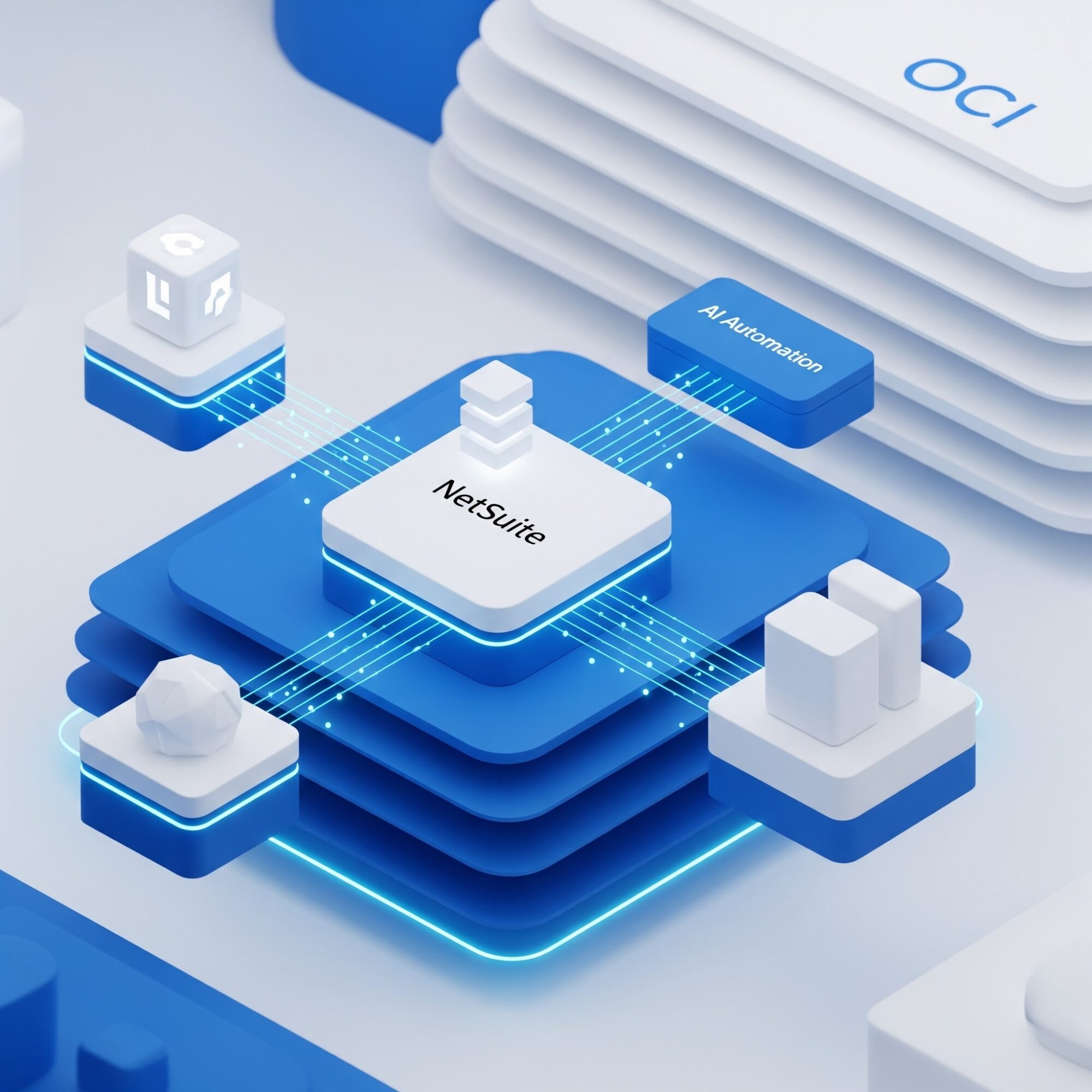
Oracle Integration Cloud Release 3
Published on by Harshad Kalmalkar
Oracle Integration Cloud Release 3: The Native iPaaS for NetSuite Implementations
Oracle Integration Cloud Release 3 makes OIC the last NetSuite integrator your enterprise will ever need, thanks to end-to-end native Oracle Cloud Infrastructure data residency.
Integration-platform-as-a-service (IPaaS) products increasingly serve as enterprises’ data backbone: connecting ERP, CRM, eCommerce, analytics systems, etc…
Instead of installing third-party IPaaS to sync NetSuite with these systems, OIC Release 3 is an integrator with the same security, compliance, performance, and long-term scalability as the infrastructure underlying the ERP system itself. Once data enters, it never needs to leave OCI.
| Capability | Earlier Generations | 3rd Generation (OIC Release 3) |
| Architecture | Monolithic, tightly coupled | Containerized microservices on Kubernetes |
| Scaling | Manual, vertical | Auto-scaling, elastic horizontal scaling |
| Integration pattern | Point-to-point or hub-and-spoke | API-first, event-driven |
| Intelligence | None or basic recommendations | Embedded AI/ML, generative AI agents |
| Real-time | Batch-focused or near real-time | Native streaming and event processing |
| Governance | Manual or policy-based | AI-assisted with comprehensive observability |
Oracle positions OIC Release 3 explicitly as an “AI automation platform” combining integration, process automation, and artificial intelligence in a fully managed environment. The container ized, Kubernetes-native architecture enables independent service scaling: if one component experiences demand spikes, only that component scales, without affecting others.
What OIC Release 3 delivers for NetSuite implementations
Oracle Integration Cloud Release 3, first deployed in August 2022 but continuously enhanced in the years since, brings substantial capabilities for ERP integration scenarios. Performance benchmarks show up to 50% improvements in latency under high transactional loads compared to earlier versions, with payload size limits increased from 10MB to 100MB for REST and SOAP adapters—critical for large batch operations common in NetSuite implementations.
The new NetSuite REST Adapter (January 2026) specifically addresses NetSuite’s transition from SOAP to REST APIs, supporting SuiteQL for advanced queries, RESTlets for custom endpoints, and OAuth 2.0 authentication. This timing is significant: Oracle NetSuite is retir ing SOAP Web Services with the 2026.1 release, making REST-native integration capabilities essential for future-proofing.
Projects represent a major organizational enhancement—workspace containers that group integrations, connections, lookups, and deployments with role-based access control. Each project supports up to 100 integrations, 50 connections, and native GitHub integration for version control. For NetSuite implementations involving multiple integrations (CRM sync, eCommerce orders, EDI trading partners), Projects enable clean separation with granular permissions.
The embedded AI capabilities deserve particular attention:
• OCI Document Understanding extracts data from invoices, contracts, and receipts auto matically
• AI-powered data mapping provides intelligent recommendations based on usage patterns and crowd-sourced mappings
• Generative AI agents can draft contextual responses, summarize records, and classify incoming data
• Human-in-the-Loop (HITL) orchestration enables approval workflows within automated processes
Oracle claims these capabilities enable 6x faster integration development compared to custom coding approaches and 60% faster innovation cycles through machine-learning recommendations.
The native Oracle Cloud Infrastructure architecture advantage
Oracle Integration Cloud runs natively within Oracle Cloud Infrastructure—not merely hosted on OCI, but architecturally integrated with Oracle’s security, networking, and data services.
Data residency is built into the architecture. Customer data remains in the region where it’s stored and processed, with Oracle committing not to move data outside the region without authorization. OCI operates 35+ commercial regions across 24 countries, including specialized sovereign cloud options: EU Sovereign Cloud (physically isolated from commercial regions), UK Sovereign Cloud (operated exclusively by UK nationals with Security Check clearance), and US Government Cloud (aligned to federal security frameworks).
The security architecture reflects what Oracle calls “security-first” design:
- Network virtualization implemented outside the hypervisor, preventing threat propagation between hosts even if a hypervisor is compromised
- Hardware root of trust with protected firmware components wiped between tenancies • Deny-all network configuration by default, requiring explicit permission for any access • MACsec encryption (IEEE 802.1AE) on private WAN connections between availability domains
- Always-on AES-256 encryption for data at rest
From a compliance perspective, OCI maintains 80+ certifications including SOC 1/2/3, ISO 27001/27017/27018, PCI DSS, HIPAA, HITRUST CSF, FedRAMP High, and GDPR. NetSuite, now running on OCI infrastructure, shares this compliance posture—meaning integrations between NetSuite and OIC Release 3 benefit from consistent security controls, without additional attestation complexity.
Performance benefits from architectural proximity: Intra-availability domain latency within OCI is ~0.25 milliseconds, as traffic between NetSuite and OIC Release 3 leverages Oracle’s backbone network rather than traversing the public internet. For high-volume integration scenarios—real-time inventory sync, order processing, financial consolidation—this latency reduction compounds meaningfully.
NetSuite Integration Platform and developer productivity
Oracle has rebranded OIC Release 3 as NetSuite Integration Platform (NSIP) for NetSuite customers, bringing enterprise-grade iPaaS capabilities directly into the NetSuite ecosystem. Developers reap the benefits of this “native understanding” with the native NetSuite Adapter.
The adapter handles polymorphic NetSuite data by elevating records and custom objects to strongly-typed data structures—eliminating the complexity developers face when mapping NetSuite’s flexible data model to rigid external schemas. It automatically discovers WSDLs based on user accounts, supports full CRUD operations on standard and custom records, and exposes custom fields directly in the visual mapper without manual configuration.
Saved search support enables integrations to invoke existing NetSuite saved searches, including pagination, custom response columns, and additional filter criteria. This is significant because saved searches represent substantial business logic in most NetSuite implementations—the ability to reuse them in integrations avoids duplicating complex filtering and joining logic.
Token-Based Authentication (TBA) comes preconfigured with 100 concurrent requests through an auto-installed Oracle client application. The adapter supports both synchronous operations for real-time needs and asynchronous invocation for large batch processing, with OAuth 2.0 now required for SuiteCloud Development Framework integration.
Pre-built integration recipes accelerate common scenarios:
- Salesforce opportunity-to-NetSuite sales order flows
- NetSuite-to-Jira project task synchronization
- Autonomous Data Warehouse imports for analytics
- FTP file imports for batch processing
The 100+ pre-built adapters in Oracle Integration Cloud Release 3 extend connectivity beyond NetSuite to Salesforce, SAP, Workday, Microsoft Dynamics, Shopify, Stripe, Snowflake, and dozens more—so that NetSuite can be the financial hub of a broader application ecosystem.
NetSuite Analytics Warehouse creates a unified data story
NetSuite Analytics Warehouse (NSAW) represents the analytics complement to OIC Release 3’s integration capabilities. Built on Oracle Autonomous Data Warehouse and Oracle Analytics Cloud, NSAW provides a pre-built data warehouse specifically designed for NetSuite data.
The architecture leverages Oracle Exadata infrastructure with massively parallel processing, columnar storage, and autonomous capabilities (self-tuning, self-patching, self-scaling). For NetSuite customers, this means analytics on large historical datasets that exceed SuiteAnalytics limits—with implementations typically completing in 2–6 weeks rather than months for custom data warehouses.
NSAW connects to OIC Release 3’s integration layer in a complementary architecture: External systems → OIC R3 → NetSuite ERP → NSAW → AI-powered insights
As stated above, Oracle Integration Cloud Release 3 orchestrates data flows from CRM, eCommerce, logistics, and legacy systems into NetSuite as the transactional system of record. NSAW itself also has direct connectors to 30+ external sources including Google Analytics, Amazon, Salesforce, and Shopify. The Multi-Instance Connector aggregates data across multiple NetSuite accounts—particularly useful for private equity firms, holding companies, and franchisors.
Customer implementations report concrete results: 50% faster report generation at a major graphics distributor, 66% infrastructure cost reduction at a large manufacturer, and quarter-end reporting time cut from three weeks to one week at a consumer electronics company.
The AI capabilities include Auto-Insights (automatic anomaly and trend visualization), Explain (AI-identified drivers and contextual insights), and conversational queries through Oracle Analytics AI Assistant. Predictive models, such as for customer churn and inventory stockouts, come pre-built, enabling analytics that inform action rather than just report history.
Autonomous close points toward AI-driven finance
At SuiteWorld 2025, Oracle unveiled NetSuite Next with Autonomous Close: an AI-powered vision for continuous financial close automation. Although this was a ”forward-looking” feature (North American previews expected by Q4 2026, global availability in 2026–27), it signals Oracle’s strategic direction, and portends the future of ERP and integrations systems.
The concept: rather than scrambling at month-end, AI monitors transactions continuously throughout the accounting period. Exceptions and reconciliation variances surface as they occur. Background reconciliations run automatically. The Close Manager dashboard tracks progress with visibility into which tasks are complete, automated, or require human review. Oracle reported 98% touchless transactions in internal testing.
Although Autonomous Close is not directly powered by NSIP/OIC Release 3—it’s built natively into NetSuite Next using SuiteCloud Platform, agentic workflows, and AI Connector Services.
NetSuite Integration Platform plays a complementary role to Autonomous Close by integrating external data sources needed for NetSuite Next to operate effectively. In other words, an organization that uses Oracle Integration Cloud Release 3 to consolidate data from subsidiaries, trading partners, and external systems will have cleaner data flowing into Autonomous Close.
The broader agentic workflow framework in Oracle Cloud Infrastructure-enabled NetSuite makes possible AI-driven processes for payment proposals, vendor selection, and automated reconciliations—all of which depend on a sound integration infrastructure.
Conclusion: architectural choice as strategic decision
The integration platform decision for NetSuite implementations is fundamentally an architec tural choice. Organizations can evaluate their needs against what native architecture provides:
Data residency and compliance: For organizations in regulated industries or with data sovereignty requirements, native OCI architecture means data flows remain within Oracle infrastructure with 80+ compliance certifications and sovereign cloud options.
Performance at scale: 0.25ms intra-OCI latency, 100MB payload support, and elastic auto scaling matter for high-volume NetSuite implementations with real-time requirements.
Developer productivity: The native NetSuite Adapter’s polymorphic data handling, saved search support, and pre-built recipes reduce implementation time—6x faster dev, per Oracle.
Platform convergence: As NetSuite moves to Oracle Autonomous Database, as NSAW con solidates analytics on Oracle Cloud Infrastructure, and as Autonomous Close emerges within NetSuite Next—OCI-native integration positions organizations for architectural alignment with Oracle’s strategic direction, and with the future of NetSuite.
AI-embedded capabilities: Document understanding, intelligent mapping, generative AI agents, and human-in-the-loop orchestration where you need it—at the point of integration.
The choice between native and non-native integration architectures depends on organizational priorities. While there’s no universally correct answer, native OCI architecture offers NetSuite customers unmatched capabilities in data residency, performance, compliance, and platform convergence—key factors in any enterprise data strategy. Organizations evaluating integration platforms for NetSuite should assess these capabilities against their specific requirements for security, scale, and long-term strategic alignment.


Bose Professional + Myers-Holum, Inc.: Summer 2024 Alliance Partner Spotlight Award Winner

IBS Electronics + Myers-Holum, Inc.: Winter 2024 Alliance Partner Spotlight Award Winner
