Most NetSuite Planning and Budgeting implementations don’t exceed budget because the software is difficult. They exceed budget because organizations discover, too late, that their ERP wasn’t ready for connected planning.
The irony is that the planning platform usually performs exactly as designed. It exposes inconsistencies that already existed in the ERP and forces implementation teams to confront them under project deadlines, when every change is more expensive. Budget templates don’t reconcile to actuals. The department structure in the planning tool doesn’t match the general ledger.
Consolidation numbers in NSPB disagree with the numbers the controller signs off on. The instinct is to blame the planning tool, or the implementation team, or both. But the real problem is that the ERP and the budget were introduced to each other for the first time mid-project, like strangers forced to share an office.
The stakes here are larger than an IT timeline. A planning model isn’t an IT deliverable; it’s how executives decide whether to hire, invest, acquire, expand, or reduce spending. When the model can’t be trusted, those decisions revert to spreadsheets, forecast accuracy erodes, and the finance transformation the CFO sponsored never actually arrives. This article explains why that happens, how to see it coming, and how to sequence a NetSuite Planning and Budgeting initiative so it delivers what it promised: faster budgeting cycles, forecasts leadership trusts, and planning agility that compounds over time.
When an NSPB implementation struggles, the root cause is almost never the planning tool. It’s the NetSuite architecture underneath it.
Your Planning Model Is a Mirror
NSPB doesn’t create planning problems. It reveals them.
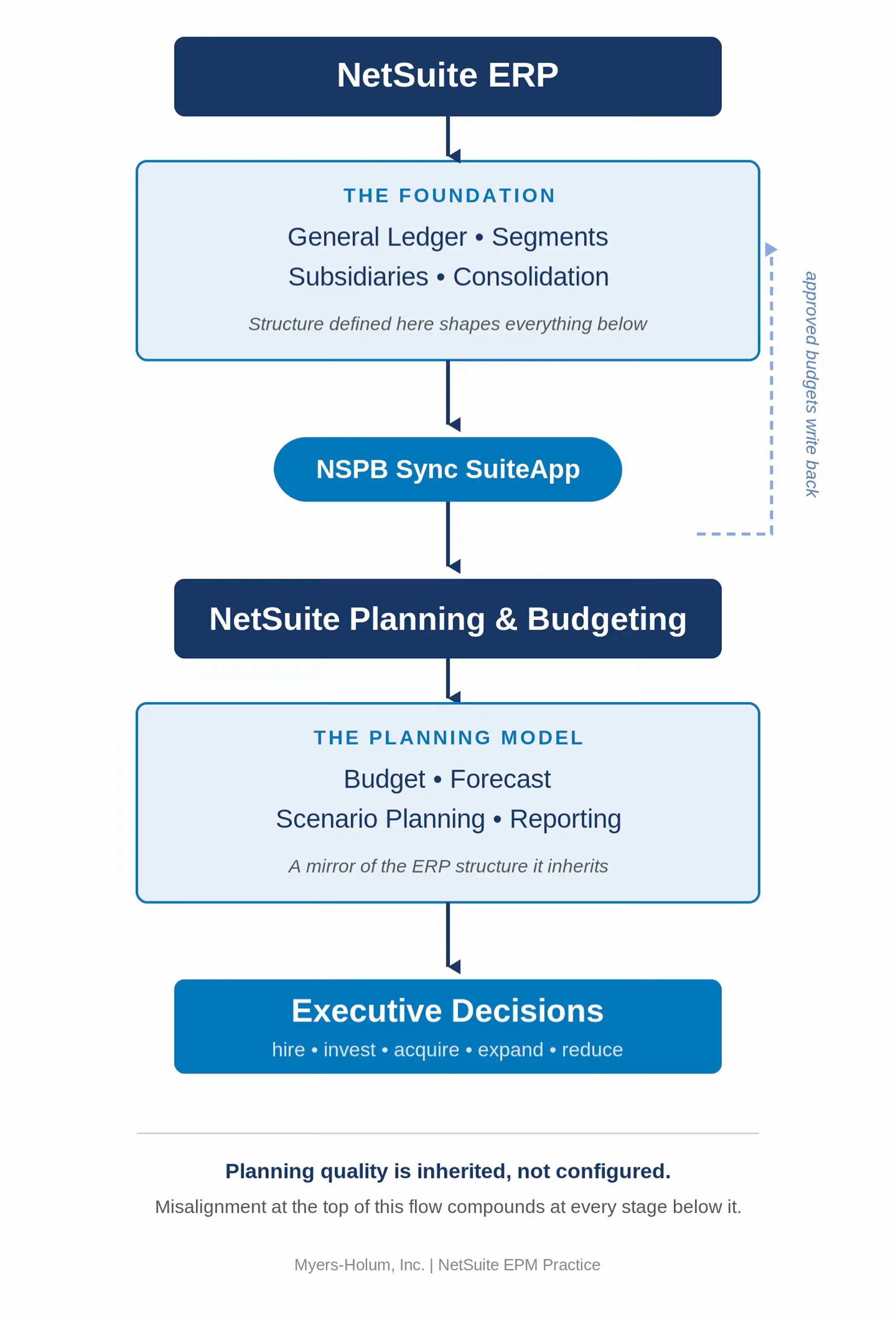
Every planning application faithfully reflects the financial architecture beneath it. NetSuite Planning and Budgeting is not a standalone application bolted onto your ERP; it is architecturally downstream of NetSuite. Your chart of accounts, segment structure, subsidiary hierarchy, and consolidation logic flow into the planning model and define its shape. If departments are used inconsistently, if subsidiaries aren’t aligned, if eliminations happen in spreadsheets, the planning model simply makes those issues impossible to ignore: on a project clock, in front of stakeholders, at the moment confidence matters most.
This is the single most useful mental model for evaluating an NSPB initiative, because it reframes the central question. The question is not “which planning tool should we buy?” or even “which partner should we hire?” It is: “what will our planning platform see when it looks at our ERP?” No amount of NSPB configuration will fix a reflection. You have to fix what’s being reflected.
Figure 1: Planning quality is inherited, not configured. Misalignment at the top of the flow compounds at every stage below it.
KEY IDEA: NSPB doesn’t create planning problems. It reveals them. Every planning application faithfully reflects the financial architecture beneath it. If the ERP is misaligned with how you plan, the planning model will make that misalignment impossible to ignore: under project deadlines, when every change is more expensive.
How NetSuite and NSPB Actually Talk to Each Other
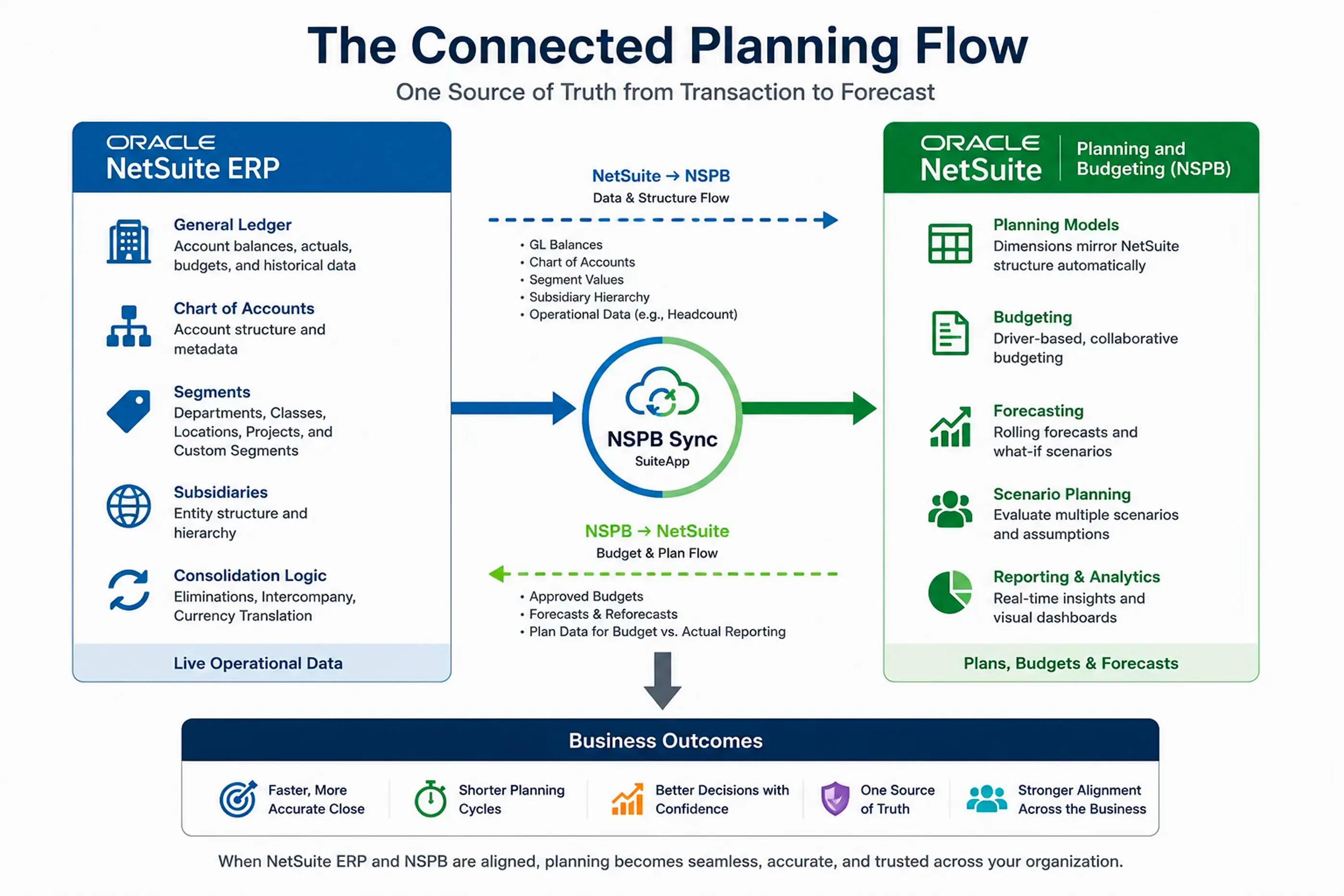
The single most attractive feature of NSPB is also the one most often taken for granted: it draws directly from live NetSuite data. Understanding that connection is the key to understanding why alignment matters. The integration runs in both directions:
NetSuite → NSPB:
Through the NSPB Sync SuiteApp, saved searches in NetSuite feed GL balances, chart-of-accounts metadata, segment values, headcount, and operational data into the planning application on a scheduled or on-demand basis.
Structure flows with the data:
NSPB imports your accounts, subsidiaries, departments, classes, and locations as planning dimensions, so budget templates and forms mirror the ERP. Scenario templates are populated dynamically from the general ledger and adapt as segments and currencies change.
NSPB → NetSuite:
Approved budgets flow back into NetSuite, enabling budget-vs-actual reporting inside the ERP your teams already work in, and giving actuals a direct path into rolling forecasts and continuous planning.
Figure 2: The connected planning flow: one source of truth from transaction to forecast.
That tight coupling is the entire value proposition: a single source of truth from transaction to forecast, and the foundation for shorter budgeting cycles and forecasts executives actually trust. This integration cuts both ways. NSPB inherits whatever the ERP gives it, faults included. A cluttered chart of accounts becomes a cluttered planning dimension. Inconsistent department usage becomes budget templates nobody believes. Consolidation left in spreadsheets becomes a planning model that never ties to the close. The sync doesn’t judge the structure it carries; it replicates it, faithfully and on schedule.
Teams that treat NSPB as a standalone project (a planning tool to configure in isolation, with the ERP handled “later”) discover these problems at the worst possible time: mid-implementation, when fixing them means rework, timeline extension, and eroded confidence. The implementations that succeed treat NetSuite alignment as a prerequisite, not an afterthought. That’s why our engagements typically begin with alignment before configuration.
The Critical NetSuite Prerequisites
Before a single NSPB form is built, three areas of NetSuite architecture need to be assessed and, where necessary, remediated.
GL structure
Your chart of accounts is the skeleton of the planning model. NSPB imports GL accounts and segments so that planning templates mirror the ERP. If the chart has grown by accretion (hundreds of active accounts, departments encoded in account numbers, inconsistent rollups), the planning model will faithfully reproduce that complexity. The right time to rationalize the chart is before implementation, when the change costs a design workshop rather than a rebuild. A chart of accounts leadership can navigate produces variance reports leadership can act on.
Data model and segment discipline
Subsidiaries, departments, classes, and locations are the dimensions your plans will be built on. They need to be used consistently across entities and mapped deliberately to how the business actually manages performance. A segment structure designed for one-off reporting requests will produce a planning model designed for one-off reporting requests. Disciplined segments mean plans roll up the way the business is truly run, which is what makes driver-based planning possible later.
Consolidation logic
Multi-entity companies frequently maintain eliminations, currency translation, or intercompany logic outside NetSuite, usually in spreadsheets. When that happens, NSPB has nothing authoritative to inherit, and the implementation team faces a choice between rebuilding consolidation inside the planning tool (duplicating effort and creating drift) or planning on numbers that don’t match the close. Neither is acceptable. This is precisely the problem NetSuite Close Management and Consolidation (CMC) exists to solve. CMC brings eliminations, intercompany matching, currency translation, and consolidated reporting into NetSuite as a governed, repeatable process, giving NSPB a single authoritative consolidation to inherit. NetSuite Account Reconciliation (NSAR) completes the picture by certifying the balances behind that consolidation: reconciliations are automated, documented, and signed off before the numbers flow downstream. Together, CMC and NSAR turn the close from a spreadsheet exercise into a system of record, so the actuals feeding NSPB arrive clean, complete, and on time, because a forecast is only as fresh as the close behind it. Consolidation belongs in NetSuite, settled with CMC and NSAR before planning is layered on top.
The Alignment Assessment: Five Questions
You don’t need a six-week diagnostic to know where you stand. These five questions, answered honestly, reveal most alignment risk before it becomes rework:
GL clarity. Could a new hire understand our chart of accounts in an afternoon, or does it require tribal knowledge to navigate?
Segment consistency. Do departments, classes, and locations mean the same thing in every subsidiary, and do they match how leadership really reviews performance?
Consolidation home. Does our consolidated P&L come entirely out of NetSuite, or does it make a stop in a spreadsheet on the way to the board deck?
Historical data quality. Can we trust two-plus years of historical actuals at the level of detail we want to plan at, or were reclasses and restatements posted at summary level?
Close timing. Do actuals arrive fast enough after period end to inform the next forecast cycle, or does our close timeline make variance analysis a history lesson?
A “no” on any of these isn’t a reason to abandon an NSPB initiative. It’s a reason to sequence the work correctly: remediation first, implementation second.
What Misalignment Actually Costs
Misalignment is invisible in a sales demo and expensive in month three of an implementation. To see why, look past the consulting fee. Organizations frequently discover that consulting fees represent only a portion of total implementation cost. Internal finance resources, executive time, delayed planning cycles, redesign work, and slower adoption often outweigh the original implementation fee. Misalignment is one of the largest drivers of all of them.
The pattern is familiar to anyone who has inherited a struggling project. A GL structure’s mismatch with planning needs surfaces in the first weeks of the build, and rework begins. Consolidation logic living in spreadsheets becomes a change order. A modeling architecture designed around the old structure gets rebuilt mid-project. The implementation deploys months late, well beyond the original estimate, with partial adoption because the organization is fatigued from rework. The finance team quietly returns to the spreadsheets the project was meant to retire. The most expensive line items never appear on an invoice: the planning cycle that didn’t get faster, the forecast the board stopped trusting, the analysts who spent a year reconciling instead of analyzing.
The economics are consistent: every misalignment is cheaper to fix before implementation than during it. Rationalizing a chart of accounts as a design exercise takes weeks. Rationalizing it after budget templates, forms, and reports have been built against the old structure means rebuilding all of them: the definition of costly rework.
Every misalignment is cheaper to fix before implementation than during it. The question isn’t whether you’ll pay for alignment; it’s when, and at what price.
The Three Strangers
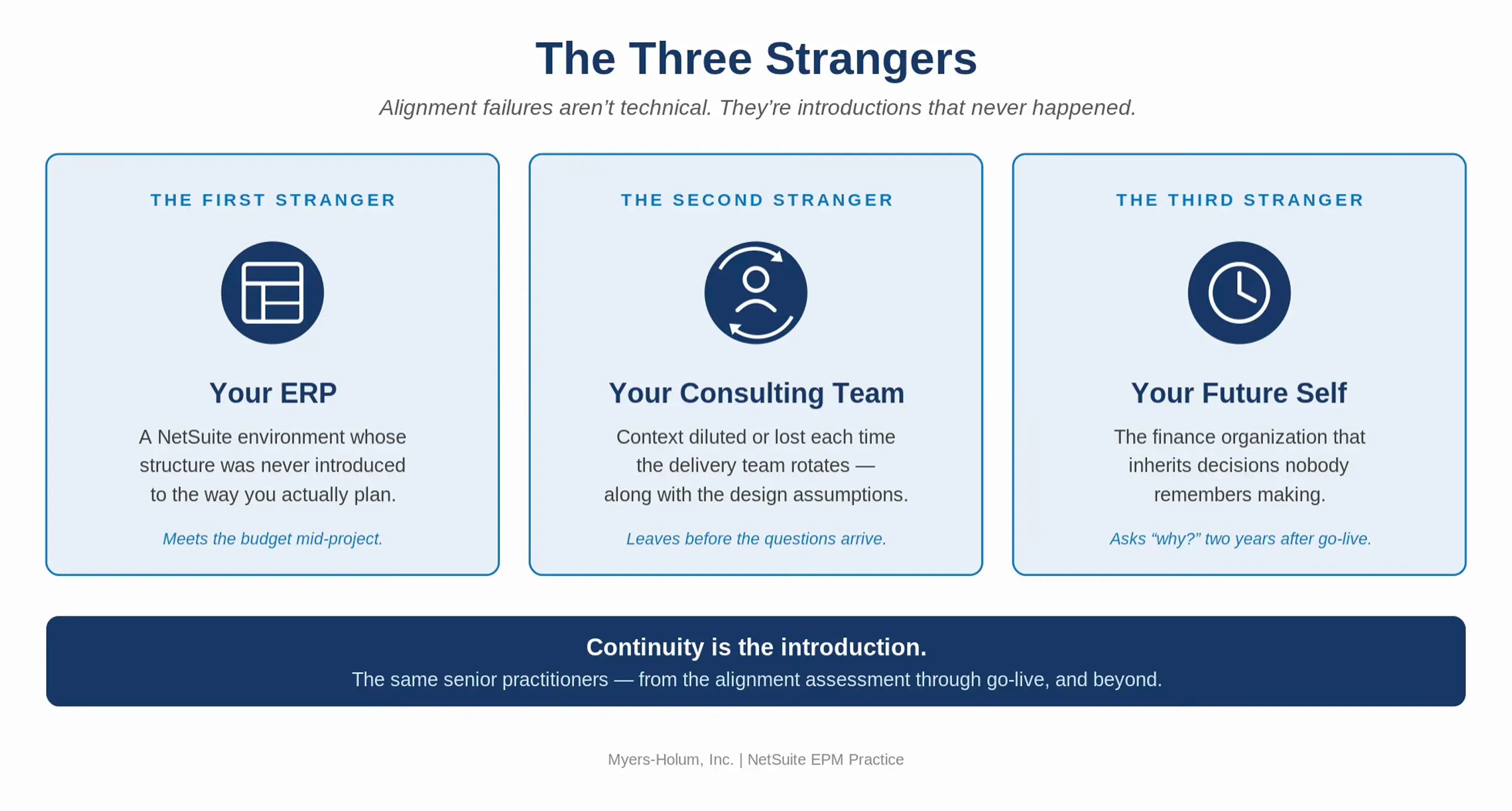
Alignment failures are usually described as technical. In our experience they are better understood as introductions that never happened, and there are three of them.
Figure 2: The connected planning flow: one source of truth from transaction to forecast.
The first stranger: your ERP
A NetSuite environment whose structure was never introduced to the way you actually plan. The chart of accounts grew transaction by transaction; the segments accreted around reporting requests; consolidation moved to a spreadsheet during a busy quarter and never moved back. None of it was wrong for the moment it was built. All of it is wrong for the planning model about to inherit it.
The second stranger: your consulting team
Large consulting firms often run staffing models optimized for scale: a senior architect designs the approach, then rotates to the next engagement while junior resources execute. For most software projects that’s survivable. For NSPB it’s corrosive, because the implementation encodes years of organizational knowledge: how revenue should be forecast, which drivers executives trust, how the GL maps to planning dimensions, why the consolidation logic works the way it does. When the team changes mid-project, that context is diluted or lost. And a discontinuous team is far more likely to discover misalignment mid-project, and far less equipped to fix it, because the people who understood the original design assumptions are gone.
The third stranger: your future self
The finance organization that inherits decisions nobody remembers making. Two years after go-live, someone asks why the model behaves the way it does, and no one can answer. Enhancements take longer. Reports get rebuilt instead of extended. The system drifts toward the spreadsheets it replaced. Continuity is what prevents this: the same senior practitioners carrying design assumptions from the alignment assessment through go-live and beyond, and documentation written for the team that comes next, not just the auditor.
This is where partner selection matters more than most evaluation processes acknowledge. NSPB alignment work sits at the intersection of ERP architecture and planning design. A partner who knows only the planning tool will configure around NetSuite problems rather than fixing them. A partner who knows only the ERP will hand off at exactly the moment continuity matters most. The teams that do this well carry deep expertise in both, and they stay.
Alignment Pays Compound Interest: Connected Planning
The case for alignment isn’t just about getting the first budget cycle live. It’s about everything you’ll want to do after. A correctly structured NetSuite foundation makes each subsequent stage of connected planning dramatically easier to add:
Workforce planning that ties headcount and compensation to the same departments the GL uses: no translation table, no reconciliation project.
Capital planning that flows into the balance sheet and cash forecast without a parallel model.
Sales and demand planning that share dimensions with financial plans instead of reconciling to them each cycle.
Driver-based planning and rolling forecasts fed by actuals that arrive clean from a disciplined close, so forecasting becomes continuous rather than an annual event.
Scenario modeling executives trust, because every scenario ties back to the same ledger the board reports come from.
Misalignment compounds in the other direction. Every workaround built into the first implementation becomes a constraint on the second, and the planning roadmap narrows precisely when the business needs it to expand. Alignment is not a project cost; it’s the down payment on planning agility.
How to Sequence the Work
Alignment doesn’t require a massive re-implementation of NetSuite. In most mid-market environments, it’s a focused, time-boxed effort that runs in four steps:
Assess. Inventory the chart of accounts, segment usage, subsidiary hierarchy, and consolidation flow against how the business actually plans and reviews performance. Document every place the ERP structure and the planning need diverge.
Prioritize. Not every gap needs fixing before day one. Distinguish structural blockers (consolidation in spreadsheets, segments that don’t reconcile) from cosmetic cleanup that can follow later.
Remediate. Execute the structural fixes inside NetSuite: chart rationalization, segment standardization, moving consolidation logic into the ERP where it belongs. This is ERP work, done by people who know the NetSuite data model deeply.
Implement. Only now does NSPB configuration begin: on a foundation that lets the sync do what it was built to do, with planning dimensions that reconcile to actuals from the first data load.
Sequenced this way, the planning implementation itself gets simpler, shorter, and more predictable, because the hard questions were answered when they were still cheap to answer.
Questions to Ask Before You Sign
Selecting a partner is more than comparing project costs. Ask questions that reveal whether the ERP and the budget will be properly introduced, and whether the people doing the introducing will stay:
Will you assess our NetSuite architecture before configuring NSPB? Good answer: a structured alignment assessment covering GL, segments, and consolidation, with remediation sequenced first. Red flag: “We can start building right away.”
Does the actual delivery team carry both NetSuite ERP and EPM expertise? Good answer: named practitioners with implementation counts on both sides. Red flag: planning-tool specialists who treat the ERP as someone else’s problem.
Who designed our proposed solution, and how much of their time is committed to delivery? Good answer: a named managing consultant meaningfully engaged throughout. Red flag: “assigned upon contract.”
How is project knowledge preserved if staffing changes? Good answer: a defined handoff process and senior-led transitions. Red flag: “Transitions are normal.”
What is your governance model for scope changes? Good answer: clear change control separating in-scope work from change orders. Red flag: “Scope is flexible.”
Can you provide mid-market references that finished on timeline and budget? Good answer: recent references with specific outcomes: adoption, planning cycle time, forecast accuracy. Red flag: only Fortune 500 references.
The answers often reveal more about project risk than any rate card.
The Bottom Line
NSPB’s promise is a planning system that speaks fluent NetSuite: actuals flowing in from the general ledger, budgets flowing back for variance reporting, one source of truth from transaction to forecast. On top of that foundation come the faster cycles, better forecasts, and planning agility that finance transformation is actually about. That promise holds only if the ERP and the budget are properly introduced before the build begins, and if the team making the introduction stays engaged from assessment through go-live and beyond.
Introduce them early, with people who speak both languages, and the planning model becomes what it should be: not a mirror of your ERP’s history, but the instrument your executives use to shape what happens next.
The answers often reveal more about project risk than any rate card.
Myers-Holum, Inc. | NetSuite Alliance Partner of the Year
Myers-Holum, Inc. is a NetSuite Alliance Partner of the Year. Our right-sized model keeps senior practitioners with deep NetSuite ERP and EPM expertise engaged from the alignment assessment through delivery across NetSuite Planning and Budgeting, Financial Close and Consolidation, Account Reconciliation, and connected planning. We measure success by outcomes: adoption, planning cycle time, and forecast accuracy.







.svg)
.svg)

