Manufacturers rarely struggle because MRP produces the wrong answer. They struggle because MRP is working from yesterday's assumptions.
Forecasts live in spreadsheets. Finance builds a budget that purchasing never sees. Buyers release purchase orders without understanding the cash implications. By the time the business discovers inventory is too high (or too low), the decision has already been made.
Connecting NetSuite ERP with NetSuite Planning and Budgeting (NSPB) closes that gap. Instead of treating purchasing as a reaction to demand, companies begin planning demand, supply, and financial outcomes together.
Two systems, one planning conversation
For manufacturers and distributors running NetSuite, material requirements planning is already doing serious work. Given a demand signal, MRP nets requirements against inventory, open supply, bills of materials, lead times, and order policies, and produces a time-phased set of recommended purchase orders, work orders, and transfers. The math is precise, repeatable, and fast.
The weakness in most environments is not the math. It is the quality and context of what goes in, and the business conversation around what comes out. A forecast built in a spreadsheet arrives late, at the wrong level of detail, with no visible assumptions. Buyers act on recommendations no one has reviewed against cash or margin targets. Finance discovers the working-capital consequence of a service-level decision at month-end close.
This is exactly the seam NSPB is built to close. NSPB is not an MRP replacement. It is the planning layer that produces a better demand signal, makes the financial consequences of supply decisions visible before commitments are made, and gives finance and operations a shared basis for deciding what to do next. Think of the relationship this way: NSPB plans. NetSuite ERP executes.
Because both are NetSuite platforms, the connection is not a bespoke integration project. Items, locations, subsidiaries, the chart of accounts, and the fiscal calendar can be aligned once and maintained as shared structures, with actuals flowing into the planning model on a defined cadence. That native affinity is what makes the phased path below practical rather than aspirational.
Figure 1: The division of labor: NSPB plans. NetSuite ERP executes.
Why phasing matters
The most common failure mode in planning transformations is trying to model everything at once: every SKU, every driver, every constraint, in one release. The result is a model that takes too long to build, is too heavy to maintain, and loses the confidence of the people it was meant to serve.
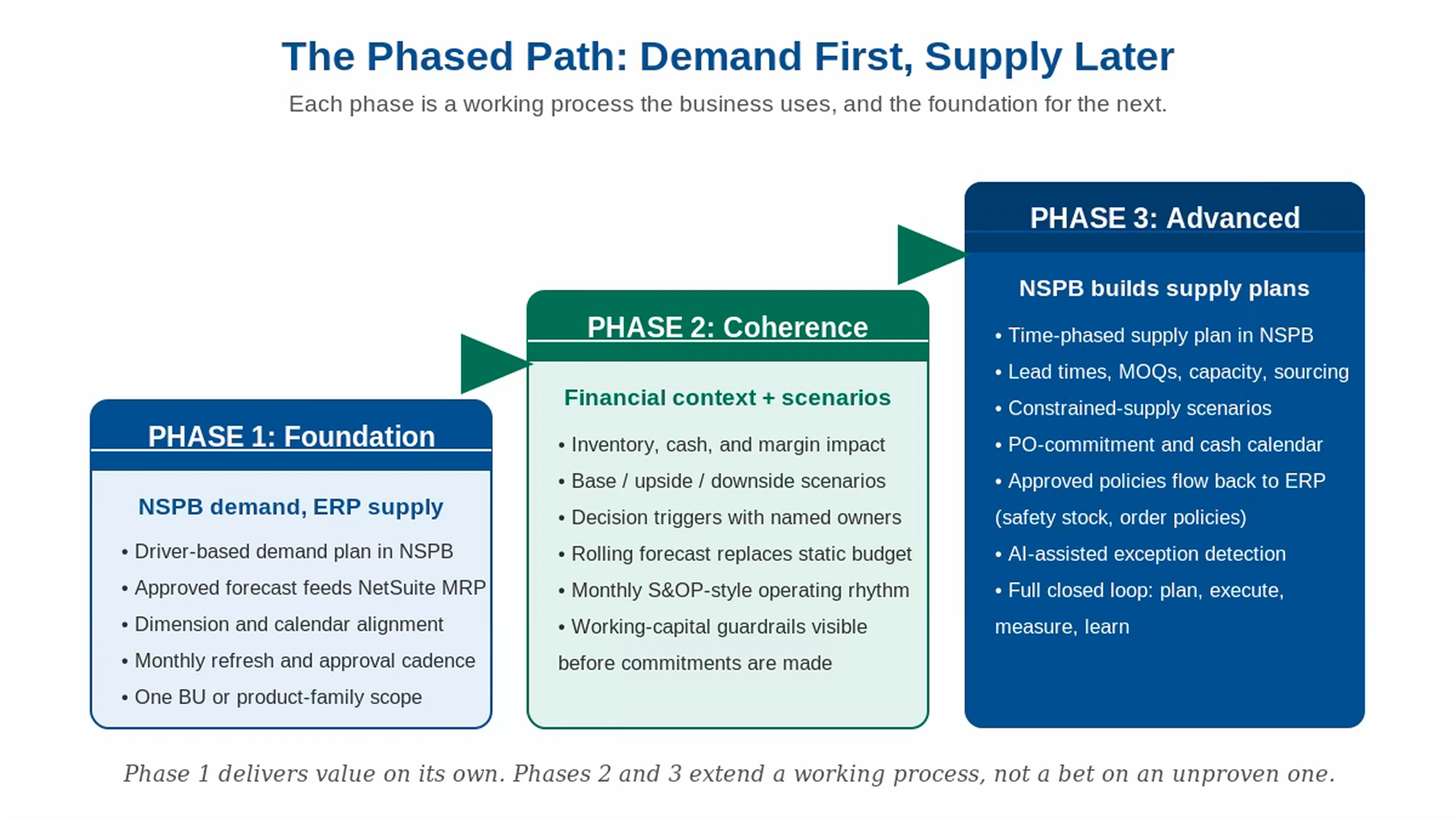
The alternative is a deliberate progression. Each phase delivers a working process the business actually uses, and each earns the trust and data discipline the next phase depends on. For most mid-market companies, the path looks like three phases.
The foundation phase respects the current division of labor and improves the weakest input: the demand signal.
In this phase, NSPB becomes the home of driver-based demand planning. Instead of a single revenue number spread evenly across twelve months, the forecast is built from the drivers that actually move demand: unit sell-through, seasonality, customer programs, channel mix, product launches, promotions, and known customer events. The plan lives at the level where decisions are made, whether that is product family and location for a broad catalog or SKU and key account for a concentrated one.
The approved demand plan is then translated into the structure NetSuite ERP expects and handed to MRP, which continues to do what it does best: net requirements against inventory and scheduled supply, apply lead times and order policies, and recommend supply actions. Procurement releases orders under the same policies it uses today.
What changes is not the supply engine. It is that the number feeding it is current, explainable, and reviewed. Sales, operations, and finance can see the same assumptions before MRP runs, and a buyer questioning a recommendation can trace it back to a specific driver rather than a mystery.
Typical Phase 1 scope: one business unit or a handful of product families, a monthly refresh cadence, dimension alignment for items, locations, and calendar, and a simple approval workflow. Most organizations can stand this up in a single focused implementation cycle, and it delivers value even if the company never goes further.
Business outcome:
Purchasing runs MRP using an approved, driver-based demand plan instead of spreadsheet forecasts.
Phase 2: Connect Operational Planning to Financial Planning
With a trusted demand plan in place, the second phase connects operational assumptions to their financial consequences.
Inventory carrying cost, supplier payment terms, freight, safety-stock policies, and open purchase commitments are brought into the NSPB model, so a change in the demand plan flows through to projected inventory value, cash requirements by month, gross margin, and working capital. Leaders stop choosing between a service-level report and a cash report; they see one plan.
This is also where scenario planning becomes an operating tool rather than an executive exercise. A base case, an upside case, and a downside case are maintained with named owners and defined decision triggers: if demand for a family runs 10% below plan for two consecutive periods, pause discretionary replenishment and review open PO coverage; if a supplier's confirmed lead time exceeds the planning assumption, revisit safety stock before the next purchasing cycle.
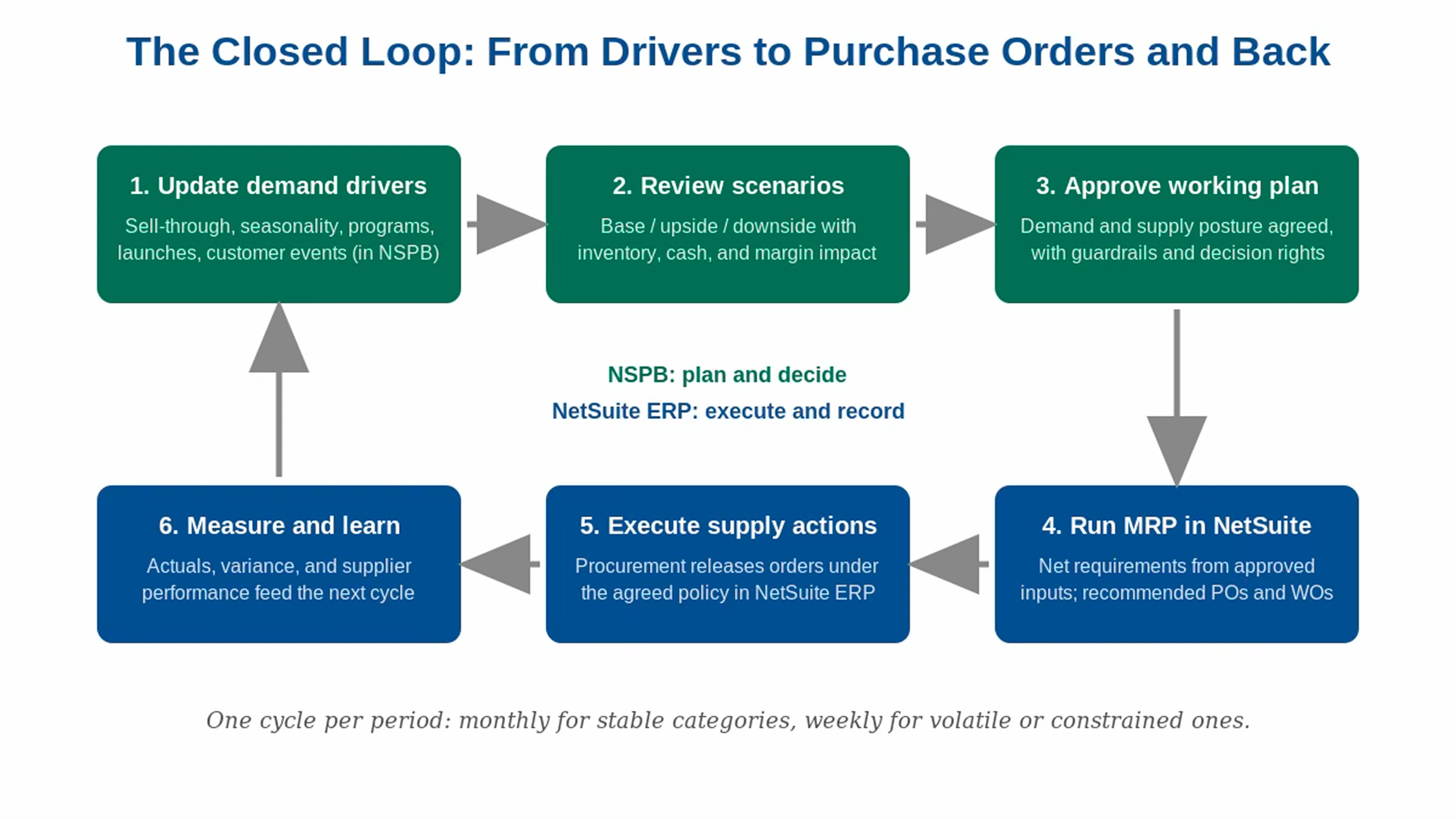
A rolling forecast replaces the static annual number as the demand signal for purchasing, refreshed monthly (or weekly for volatile or constrained categories) so MRP is always executing against the best available information. The monthly rhythm matures into a genuine sales-and-operations conversation: refresh actuals, update drivers, review scenarios, approve the working plan, run MRP, execute, measure variance, repeat.
Business outcome:
Every demand scenario immediately shows its impact on inventory, cash flow, and gross margin.
Phase 3: Build an Integrated Demand and Supply Planning Process
The advanced phase extends NSPB from planning demand to modeling supply itself. Here, the planning model carries supplier lead times, minimum order quantities, capacity limits, and sourcing alternatives, allowing the team to build a time-phased supply plan in NSPB alongside the demand plan: projected receipts, planned purchases by supplier and month, inventory positions by scenario, and the resulting purchase-commitment and cash calendar. Constrained cases become plannable: what happens to service levels and margin if a key supplier's capacity drops 20%, or if the company caps inventory investment for two quarters?
The output is a supply posture the business has chosen, not merely accepted. Approved supply assumptions (updated safety-stock targets, adjusted order policies, and revised sourcing splits) flow back into NetSuite ERP, where MRP executes against them. The loop closes: NSPB decides the plan, ERP executes the plan, actuals return to NSPB, and the next cycle starts better informed.
AI is most valuable after the planning process is working, not before. Once trusted plans and clean historical data exist, AI can identify forecast bias, detect demand shifts earlier, recommend inventory adjustments, and surface supplier risks. It accelerates analysis while leaving planning decisions with experienced finance and operations teams.
Business outcome:
Supply decisions become proactive rather than reactive, with finance and operations working from the same plan.
Figure 3: The closed loop: NSPB plans and decides; NetSuite ERP executes and records.
Three practices determine success
Align master data.
Planning dimensions must match ERP structures, including items, locations, subsidiaries, units of measure, and fiscal calendars.
Create an operating cadence.
Define who updates assumptions, who reviews scenarios, and who approves plans before purchasing decisions are made.
Keep scope practical.
Only model detail that changes real business decisions. Complexity rarely creates better planning.
Where to start
The practical first step is not an enterprise redesign. It is Phase 1, scoped to the product families or business unit where the forecast-to-purchasing handoff already causes the most friction. Align the dimensions, build the driver-based demand plan, connect it to MRP, and run the cadence until the organization trusts it. The later phases are then extensions of a working process, not bets on an unproven one.
This is where implementation partner structure matters. A phased program succeeds when the people who designed Phase 1 are still engaged in Phase 3, when the same senior practitioners who aligned your dimensions and built your demand model are the ones extending it into supply planning. Myers-Holum's right-sized delivery model is built for exactly this continuity: senior NetSuite ERP and NSPB practitioners engaged from strategy through each phase of delivery, without the handoffs of a large-firm bench or the key-person risk of a boutique.
If purchasing is still working from spreadsheets while finance plans somewhere else, your ERP isn't the problem: your planning process is. Start with one business unit. Build a driver-based demand plan. Connect it to MRP. Let the organisation gain confidence before expanding. That's how companies move from reactive purchasing to connected planning, without a risky, all-at-once transformation.
Talk to MHI about a phased NSPB and NetSuite ERP planning assessment and find out what Phase 1 would look like for your business.




.svg)
.svg)

