When a Food Safety Event Hits, Planning Is the Response
When a Food Safety Event Hits, Planning Is the Response
Using NetSuite Planning and Budgeting to navigate a produce outbreak. The 2026 Cyclospora outbreak is a reminder that a food safety event is never only a public health event. It is a planning event, and it arrives before anyone knows how big it is.
When a Food Safety Event Hits, Planning Is the Response
Using NetSuite Planning and Budgeting to navigate a produce outbreak.The 2026 Cyclospora outbreak is a reminder that a food safety event is never only a public health event. It is a planning event, and it arrives before anyone knows how big it is.
Since May 1, CDC has logged 6,707 laboratory-confirmed domestic cases of cyclosporiasisacross 45 states, with 423 hospitalizations, and is aware of more than 11,500 additional casesstill under review. One multistate cluster, 1,947 confirmed cases across nine states, has beentied to shredded iceberg lettuce sourced from central Mexico, and a voluntary recall reaching 27states has been in place since July 17.
If you grow, ship, pack, process, distribute, or retail fresh produce, you are already inside thisevent. Being implicated is not the threshold. Operating in the same commodity category is.Demand changes within days. Customers change purchasing patterns. Retailers look foralternate suppliers. Quality assurance, testing, freight, and communication costs all rise at once.
And leadership asks finance one question, usually before lunch: what does this mean for thenext 30, 60, and 90 days?
Spreadsheets were not built to answer that question in a day. Driver-based planning was.
The Financial Impact Starts Before the Recall Ends
Prior events give a clear picture of how the damage distributes, and it is not evenly. UC Davisresearchers put total societal losses from the November 2018 romaine advisory at $276 to $343million across roughly seven weeks. Processors absorbed approximately $55.3 million of it andretailers $14.1 million, while growers were largely shielded because fixed-price grower-processor contracts held. Where you sit in the chain, and what your contracts say, determineswhether an outbreak is an inconvenience or a lost year.
Substitution moves just as fast, and it does not respect the boundary of the implicated product.During that same advisory, USDA-tracked prices for a 24-count carton of iceberg, the substituterather than the implicated item, ran from $16.56 to $20.85 up to $44.35 to $45.65 inside a week.Whichever side of that move you were on, the plan of record was wrong within days.
Recovery then runs on its own clock. IFPA's member consumer pulse this month found thatconfidence is the core issue and is likely to recover more slowly than purchasing, with nearlyhalf of consumers saying the single biggest confidence-builder is simply knowing the outbreak isover. Volume returns before trust does, and promotional spending in the gap is largely wasted,because consumers said they are looking to FDA and CDC for reassurance rather than tobrands.
None of that is an accounting problem. It is a planning problem, and it is answerable.
Three Scenarios, Not One Forecast
During an outbreak, management never has complete information. The useful move is not toguess which outcome is coming. It is to hold several and price each one.
Scenario
Assumptions
What it costs
Decision it informs
Limited impact
Category volume off 5% for four weeks, no sourcing change, demand snaps back
Short revenue and margin dip, minimal cash effect
Hold the plan, absorb it, communicate calmly
Regional disruption
Several customers suspend purchases, product sourced from alternate regions, freight and promotional spend rise
Margin compression plus incremental opex, working capital tightens
Figure 1. Three scenarios, each with named assumptions. The point is not to be right about which one happens, but to know the cost of all three before you have to choose.
In NetSuite Planning and Budgeting, each of those becomes a version rather than a workbook.Version Builder exists precisely to hold best case, worst case, and what-if iterations of a forecastalongside the plan of record, so the three scenarios can be compared side by side andreconciled to the board plan instead of competing with it.
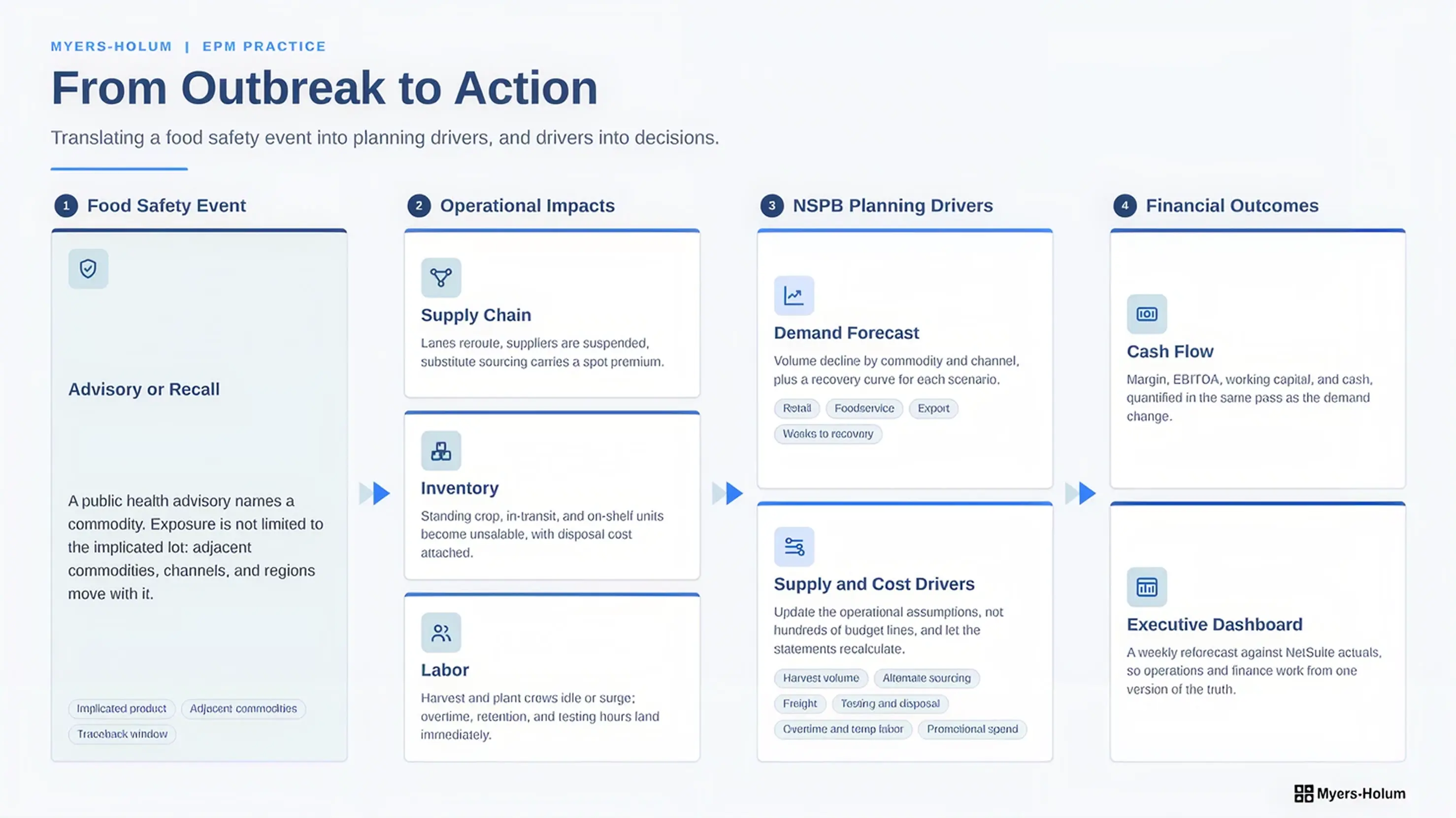
From Outbreak to Action
The mechanism matters, because it is what separates a scenario exercise from a defensiblereforecast. An event produces operational impacts. Operational impacts are expressed asplanning drivers. Drivers produce financial outcomes leadership can act on.
Figure 2. The path from a public health advisory to a decision leadership can defend, with the planning model doing the translation.
Model the Drivers, Not the Revenue Lines
The single greatest advantage of NSPB during a disruption is that you change assumptions rather than line items. Instead of touching hundreds of budget rows, planners update the operational drivers, and the statements recalculate. Three families cover most of an outbreak:
Revenue drivers
Retail, foodservice, and export demand, modeled separately because they move at different speeds.
Customer mix, commodity pricing, and promotional activity.
Weeks to first recovery and weeks to full recovery, by channel
Supply drivers
Harvest volume, available acreage, and yield assumptions
Alternate sourcing regions and the premium they carry
Inventory availability and processing capacity by facility
Cost drivers
Additional food safety testing and product disposal
Freight, overtime, and temporary labor
Marketing and communications, legal, and compliance response
Driver-based revenue, workforce, and capital plans are native structures in NSPB, and driver-based balance sheet planning carries the same assumptions into DSO, DIO, and DPO. Change the volume decline once and the effect reaches labor, inventory, and cash without anyone re-keying a number. That propagation is the part spreadsheets get wrong, and it is the part that matters when the answer is due Thursday.
One Version of the Truth for Operations and Finance
During a food safety event, operations and finance almost always end up in different files. Operations knows harvest volumes and plant schedules are changing. Finance is rebuilding a revenue forecast. Both are working hard, and neither number ties to the other.
A shared planning model removes that gap. Operational assumptions land once and flow into revenue, gross margin, EBITDA, working capital, inventory projections, labor plans, and cash. Prebuilt integration with the NetSuite general ledger means actuals arrive without a data project, so a weekly variance read against the outbreak version is realistic rather than aspirational. That cadence matters more than usual right now: CDC estimates roughly six weeks between illness onset and case reporting, which means the public data everyone is reacting to describes a situation that has already moved.
Plan for More Than One Recovery Curve
Recovery is not a single line, and treating it as one is the most common modeling error after an event. Build the curves separately and compare them:
Rapid recovery, where demand returns within weeks of the all-clear
Seasonal recovery, where the category recovers only at the next demand peak
Slow confidence recovery, where volume returns well ahead of trust and pricing stays soft
Substitution, where buyers shift permanently to an adjacent commodity
Structural change, where a customer rewrites specifications or supplier requirements
Comparing recovery paths side by side turns an argument about optimism into a conversation about exposure. It also tells you when to spend on demand generation and when spending is simply early.
Stress-Test the Supply Chain Before the Costs Appear
Outbreaks expose weaknesses that normal operations conceal. The same model answers the operational what-ifs:
What if a growing region becomes unavailable for the season?
What if imported product becomes necessary, at what landed cost?
What if freight rises 20 percent for a quarter?
What if a retailer requires additional traceability investment as a condition of supply?
What if production shifts between facilities, and what does that do to labor and overhead absorption?
Answering these before decisions are made is the difference between managing an event and reporting on one.
Traceability Is Operational. Planning Is Financial.
The industry has invested heavily in traceability, and the case for it is strong. Robust traceability lets a recall execute in hours rather than days and narrows its scope when it does, which is exactly why IFPA has opposed further delay to FDA's Food Traceability Rule. The regulatory clock has moved: the FSMA 204 compliance date, originally January 20, 2026, is now July 20, 2028, an extension Congress codified in the Continuing Appropriations Act signed in November 2025.
Read as a finance question, that delay is not relief. It is thirty additional months in which your own traceability maturity, not the regulation, determines how much of the next event lands on your P&L. And the two capabilities are complements, not substitutes.
Traceability tells you where the product went. Planning tells you where the business is going.
Five Questions to Ask Your FP&A Team This Week
If an advisory named one of our commodities on Monday, how long until the CFO has a defensible reforecast: hours, days, or weeks?
Do we know, by commodity and channel, what a 20, 40, and 60 percent volume decline does to contribution margin and to cash?
Which of our contracts pass a substitute price spike through, and which leave us absorbing it?
At what revenue decline and inventory write-down do we breach a covenant, and does anyone own that number today?
At what revenue decline and inventory write-down do we breach a covenant, and does anyone own that number today?
Uncomfortable answers are useful answers. Every one of these is a configuration exercise in a planning model, not a transformation program.
Do Not Wait for the Next Event
Food safety events are unpredictable. Your financial response should not be. Teams that already plan by driver can stand up a new scenario in hours; teams that plan by spreadsheet spend those hours rebuilding the spreadsheet, and then defending it.
The framework does not change with the disruption. Cyclospora this summer, a weather event, a labor shortage, a tariff change, a transportation failure: the model is the same, and so is the discipline. The companies that recover fastest are not the ones with the fewest disruptions. They are the ones that can evaluate several futures quickly, align operations and finance on one set of numbers, and decide before their competitors do.
Resilience is not built during a crisis. It is built in a quiet quarter, by someone who decided that an outbreak deserved a named scenario, a defined driver set, and an owner.
Talk to MHI
Myers-Holum implements NetSuite ERP and NetSuite Planning and Budgeting for mid-market food, agriculture, and distribution companies. If you want a second read on whether your planning model could produce a defensible outbreak reforecast inside a week, we are glad to have that conversation. Bring your current forecast and your driver assumptions.
This post is part of Myers-Holum’s EPM series for NetSuite Planning and Budgeting leaders.
Ready to Transform Your Business?
Turn insights into action with expert guidance tailored to your business goals.







.svg)
.svg)

