The Hidden Cost of Scope Creep in NSPB Implementations
Why a planning model can end up objectively better while the outcome ends up objectively worse
No NetSuite Planning and Budgeting project fails because someone made one bad decision. They fail because forty reasonable people made forty small ones, and nobody added them up.
Every request is defensible on its own. A dimension the sales team would find useful. A tab the controller has always had in the spreadsheet. A calculation that would take an hour, maybe two. None of them is worth a fight. Together, they are the reason your Phase 1 go-live slipped a quarter and your users still open Excel first.
Scope discipline is not a legal exercise or a contract clause. It is a delivery philosophy, and it is one of the clearest signals of whether your implementation partner is protecting your outcome or their backlog.
Scope creep is not a failure of will
The instinct is to treat scope creep as a discipline problem: someone should have said no. That framing is not wrong, but it misses why saying no is so hard, and why it fails so consistently even on well-run programs.
Start with the psychology. An NSPB implementation is the first time in years that many finance and operations people have had a designer’s full attention. Requests that have been sitting unspoken for a decade surface all at once, and they surface as small asks, because that is how people make asks they are not sure they are allowed to make. The consultant, wanting the room to stay collaborative, says “we can probably work that in.” The sponsor, wanting the team to feel heard, does not overrule them. Everyone in the room has behaved well, and the project just got longer.
Then add the incentives. On a time-and-materials engagement, additional work is additional revenue, and the firm has no structural reason to discourage it. On a fixed-fee engagement the pressure runs the other way, but the response is often to absorb small items quietly rather than raise a change order over two days of effort. Both paths lead to the same place: the addition happens, the baseline does not move, and the schedule quietly takes the hit.
Finally, add the visibility problem. Nobody sees the aggregate. The sales lead knows about their one request. The controller knows about theirs. The project manager sees a status report that has been green for five weeks because each individual item was, in fact, absorbed. The first time anyone sees the sum is when user acceptance testing starts and the calendar stops cooperating.
None of this is bad faith. Engaged stakeholders asking whether the system could do more is exactly the behavior you want. The failure is that the room keeps answering the wrong question. “Can NSPB do this?” is almost always yes. “Should NSPB do this in Phase 1?” is a different question, and it is the only one that governs your date.
The arithmetic of a quick addition
The estimate a consultant gives in the room is almost always an estimate of the build. It is usually accurate. The problem is that in a connected planning application, the build is rarely the expensive part.
Consider a genuinely modest request: add a headcount detail tab so managers can plan at the position level rather than by department total. Two days to build the form and the underlying calculation, and the estimate is fair. What follows is not in the estimate. The change in granularity touches the dimension design, which means the data integration has to carry a new level of detail, which means the mapping and validation rules need rework. Every report that rolls up headcount has to be retested. Security and approval workflow have to be extended to a new class of user. The training deck and the user guide are out of date. And the model carries that complexity into every future release, every upgrade, and every new person who has to learn it.
This is not an argument peculiar to consultants. Oracle’s own design guidance says the same thing structurally: an EPM Planning application supports up to 32 dimensions, but the recommended practice is to include fewer than 12, and dimension design “can have a big impact on reporting and calculation performance.” The constraint is deliberate. Dimensionality is an architectural decision, not a form-design decision, which is precisely why the estimate and the impact diverge so sharply.
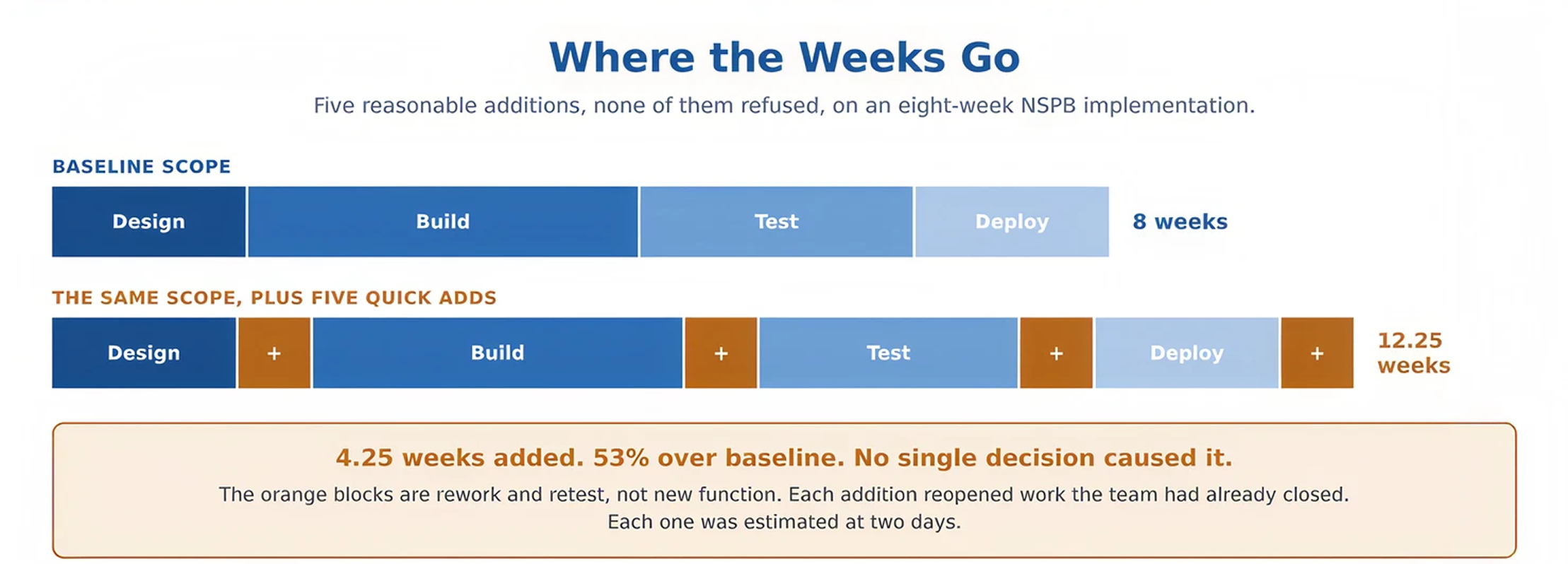
Two days becomes nine to fourteen. Most NSPB implementations run eight weeks or less, which is exactly what makes this arithmetic unforgiving: there is no slack in a short project to absorb a surprise. Do it five times, which is a completely ordinary number of additions, and you have added four or five weeks to an eight-week plan. Not because the team was slow, and not because any one request was unreasonable, but because each addition reopened work that had already been closed and tested. The developer sees the two-day build. The project manager sees the nine-day impact. The CFO sees a quarter of delayed benefit.
Figure 1. Five additions, none of them refused, on an eight-week implementation.
The costs that never appear in a status report
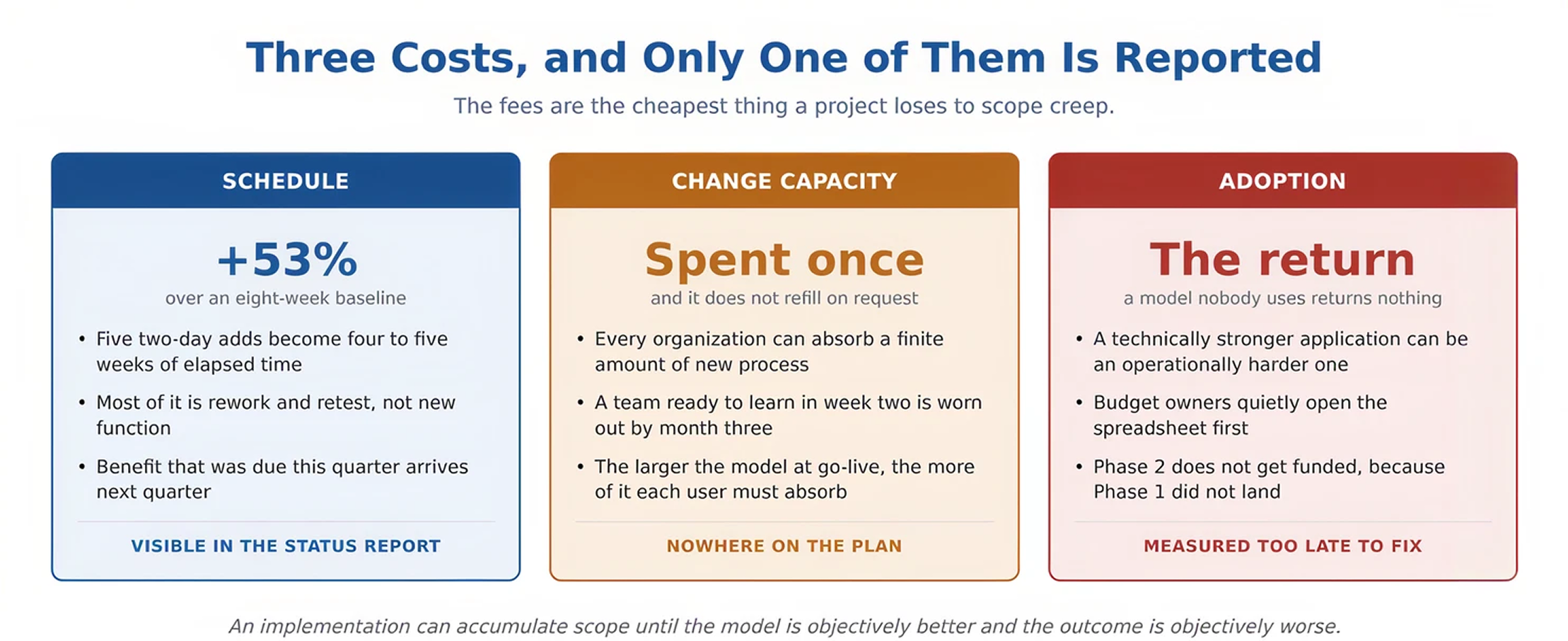
The schedule cost is the part that gets reported. The two that matter more do not.
The first is change capacity. Every organization has a finite ability to absorb new process, and a planning implementation spends most of it. A team that was ready to learn one new way of working in week two is worn out by the time a larger, later, more complicated version of it arrives in month three. Scope creep does not just delay adoption. It consumes the goodwill that adoption depends on.
The second is adoption itself, which is the only place the investment actually pays. And this is where the paradox sits: an implementation can accumulate scope until the model is objectively better and the outcome is objectively worse. The model that was meant to replace five spreadsheets now also introduces three dimensions, a changed approval workflow, position-level planning, and a dozen new reports. Technically it is a stronger application. Operationally it is a harder one to adopt, and an application nobody adopts returns nothing at all.
Figure 2. Only the first of these three costs shows up on a project plan.
The goal of Phase 1 is not the most comprehensive planning model the team can build. It is the smallest model that materially improves the decisions the business actually makes each month. Every addition beyond that is spending three budgets at once, and only one of them is money.
The real cost is not the consulting fees. It is the delayed benefit of a planning process that was supposed to be running a quarter ago, plus the change capacity you spent getting there.
Why large firms enable it, and small firms cannot prevent it
Firm structure shapes how scope requests get handled, and the two extremes of the consulting market fail in opposite ways.
Large firms bring real depth, and on the largest programs that depth is decisive. But they are built around utilization. A bench that has to be kept busy makes additional scope an asset rather than a risk, and the engagement model reinforces it: the partner who scoped the work is not the person delivering it, and the delivery team has neither the context to know what was deliberately excluded nor the standing to refuse. Requests get accepted because accepting is easier than escalating to someone who joined the account for the pursuit and has not been in a working session since.
Boutique firms have the opposite problem. They usually want to hold the line, and often the individual practitioner has the judgment to do it. What they lack is the structure: no independent project management function, no methodology that requires a change order, and a commercial relationship where the client is a meaningful share of annual revenue. Declining a request from a client who represents twenty percent of the year is a different conversation than declining one who represents two percent.
The firms that hold scope reliably tend to sit between the two: large enough to have a real methodology and independent project management, small enough that the people who designed the solution are still in the room when the requests start arriving. Continuity is what makes a considered refusal credible. A consultant who helped write the scope, and who will still be there at go-live, can say exactly what a request displaces. A consultant who arrived in week three cannot.
Where scope is actually controlled
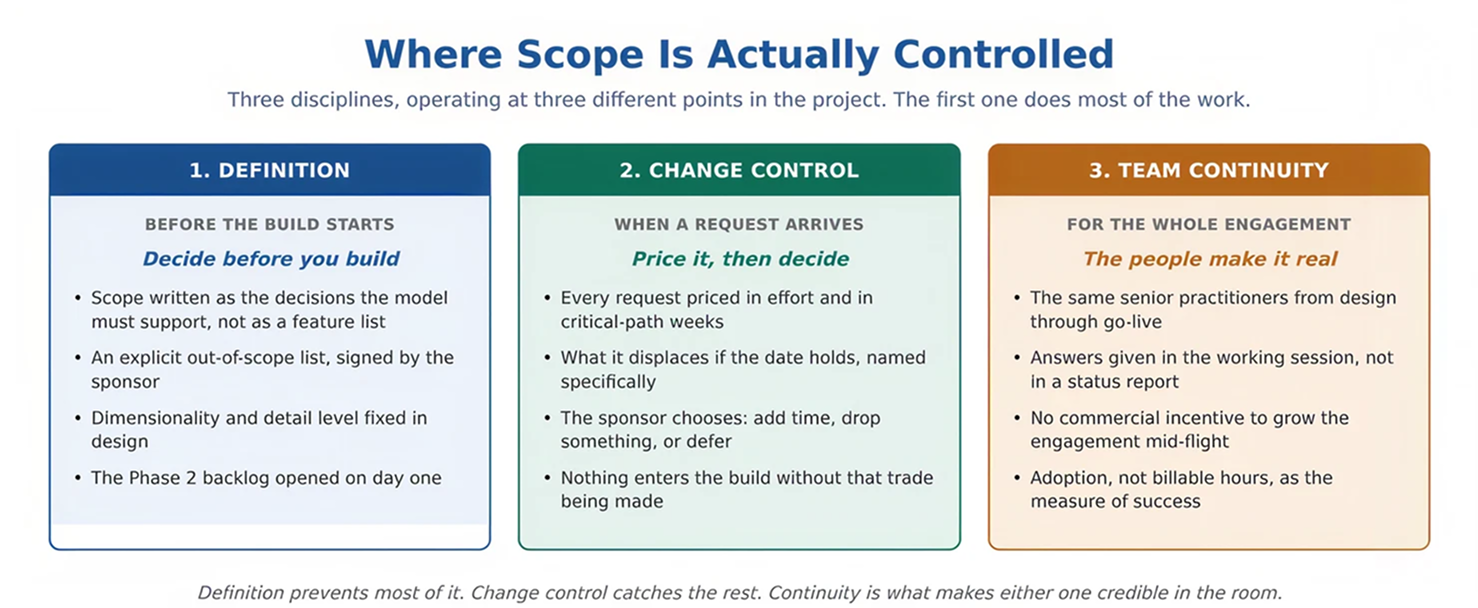
Scope control is not one behavior. It is three, and they operate at different points in the project.
Figure 3. The three disciplines, and where each one operates.
1. Definition
Most scope creep is prevented before the build starts, in how the scope was written. Scope stated as a feature list invites additions, because any new feature sounds like a peer of the ones already listed. Scope stated as a set of decisions the model must support gives you a test: does this request change a decision the business makes, or does it change a screen? Oracle’s dimension-design guidance follows the same order, identifying the planning processes first and then determining which dimensions those processes require, rather than asking users to enumerate everything they might one day want to analyze. An explicit out-of-scope list, signed by the sponsor, is worth more than any amount of detail in the in-scope list. So is fixing dimensionality and detail level in design, because those two choices drive most of the downstream cost. And open the Phase 2 backlog on day one, so that “not now” has somewhere to go.
2. Change control
Some requests are genuinely worth making, and a process that cannot accommodate them is not discipline, it is rigidity. The discipline is that every request gets priced in both effort and schedule, and the sponsor makes an explicit trade: add time, drop something else, or defer it. What must never happen is the fourth option, where the item enters the build and the schedule absorbs it silently. If the CFO wants a capability badly enough to move go-live by two weeks, that may well be the right call. The point of change control is not to refuse things. It is to make sure the person accountable for the date is the person who decides.
3. Team continuity
The first two are process, and process only works if the people running it will use it. That means senior practitioners who stay on the engagement from design through go-live, answers given in the working session rather than flagged in a status report three weeks later, and a commercial model that does not reward growing the engagement mid-flight. It is a small thing that turns out to matter enormously: the ability of the person in the room to say “we can do that, and here is what it costs you,” in the moment, with authority.
What that looks like in practice, and how a request gets sorted, priced, deferred, or declined in the four seconds after it is made, is the subject of the companion article to this one, The Four-Second Decision.
What it looks like when it works
A hospitality company came to us after an NSPB implementation with a previous partner had run months past its original date and gone live with a model most of the budget owners had quietly stopped using. The model was not wrong. It was simply far larger than the process it was meant to support, carrying detail that had been added request by request over the course of the build.
The rebuild started from a different question. Rather than asking what the model should contain, we asked what decisions leadership needed to make each month and what the model had to produce to support them. That produced a materially smaller scope, an explicit out-of-scope list the CFO signed during design, and a Phase 2 backlog that opened in week one rather than becoming a dumping ground at the end.
Sixteen requests arrived during the build. Five were already in scope and were simply built. Four were accepted with priced change orders the sponsor approved. Six went to the backlog with an owner and a review date. One we recommended against building at all, and explained why. None entered the build without that decision being made explicitly.
Result: Delivered on the original date, at the original scope. Five backlog items were later built in Phase 2. The rest, examined with a working process in hand, turned out not to be worth building.
The questions worth asking before you sign
Most evaluation processes ask a prospective partner about methodology, references, and certifications. Those matter, and every credible firm will pass. A more revealing question is this one: tell me about a time you recommended against something a client wanted.
Then listen to how far they can take it. What did the client want, and why did you advise against it? What would it have done to the architecture or the date? Who made the final call, and what happened to the relationship afterward? A firm that practices scope discipline has these stories in detail. A firm that puts it on a slide does not.
Then make it about your project. Who will be in the room in week five, and is it the same person who is in the room today? What happens, procedurally, when a request arrives mid-build? Who prices it, and who approves it? Ask to see a real out-of-scope list and a real Phase 2 backlog from a delivered project. Those two documents are the evidence that the process exists, and a firm that has them will produce them in a day.
A partner who protects your scope is protecting something more valuable than your budget. They are protecting the date your business starts getting value from the investment, and your team’s willingness to adopt what you built.
If your last planning implementation ran long and nobody can point to the decision that caused it, it was not one decision. It was the absence of a process for making them.
Talk to Myers-Holum about a Scope Discipline Consultation, and find out what a defensible Phase 1 scope would look like for your organization.







.svg)
.svg)

