Black Friday is days away. Your marketing calendar is set, your promotions are queued, and your warehouse has staffed up for the rush. But there's one question many growing businesses don't ask until it's too late: can the systems that move your orders actually keep up?
For high-volume businesses, the bottleneck on the biggest sales day of the year often isn't demand, inventory, or even the warehouse. It's the integrations connecting your storefront, your ERP, and your fulfillment partners. And the difference between a record-breaking weekend and a costly scramble usually comes down to one design principle.
"When designing integrations, we must size for peak volumes rather than average volumes," says Mo Risad, an integration leader at Myers-Holum. "Peak throughput is the metric we target during implementation. For example, we set companies up for success by preparing them for the maximum number of orders per hour over the past year."
Are you planning for your Black Friday volume?
Most integrations are built around everyday operations. They work smoothly on a typical Tuesday, so nobody thinks twice about them. But Black Friday and Cyber Monday don't look like a typical Tuesday. Daily volume can double, triple, or quadruple, arriving in concentrated bursts rather than a steady stream.
If you've grown quickly, the gap may be wider than you think. A business whose transaction volume has doubled year over year is effectively running a different operation than the one its integrations were originally sized for. And businesses still running on entry-level accounting tools and manual processes face an even steeper climb when the holiday surge hits.
The good news is, this is a measurable, solvable problem — and you don't need a teetering tech stack to handle it.
What happens when integrations can't keep up
Many businesses rely on traditional point-to-point integrations. In this model, records are pulled from a source system (like an e-commerce platform), lookups and transformations happen in memory during a single execution, and the result is posted to the destination system. Nothing is persisted in between.
That approach works well at modest volumes. Under peak load, it can start to break down:
Timeouts and concurrency limits. Every system — any ERP, any 3PL, any API — has limits on how many requests it can process at once. When a surge of orders exceeds those limits, requests get rejected, and in a point-to-point design those orders simply error out and don't sync.
Manual recovery. Whether caused by concurrency issues or bad data, failed orders have to be found at the source and retried, adding work for IT teams at exactly the moment they're most stretched.
Downstream ripple effects. Bottlenecks can appear at several points — importing orders into the ERP, sending them to the 3PL, or reading data back out while large volumes are being written.
The business impact is real. "Warehouse teams are put on standby for high-volume events," Mo explains. "They staff up based on anticipated order volumes, and you end up paying for those workers whether orders flow or not. If orders don't reach the 3PL in time, workers sit idle, and you fall behind schedule."
In other words, an integration bottleneck on Black Friday can result in paying for labor that doesn’t have orders to fulfill, shipping late on your most visible weekend, and spending the following week reconciling errors instead of celebrating results.
How Myers-Holum helps high-volume businesses win the peak
1. Start with the math: a peak volume assessment
Myers-Holum performs volume analysis for every domain we integrate, identifying peak hourly throughput and comparing it against the capacity of each connected system. At low volumes, this is a formality. As daily order counts climb into the thousands, it becomes essential.
"Designing for peak output reveals platform constraints, such as licensing or concurrency," says Mo. "As implementers, our job is to analyze volume and advise clients on necessary changes to accommodate their requirements."
That assessment isn't a one-time exercise. Live clients often come to us a month or two before Black Friday with a simple question: our volume is going to triple this year — will this still work? We rerun the analysis and recommend specific changes so there are no surprises on the big day. In the rare case that a proposed volume simply isn't a good fit for a given design, we say so early and help redesign the solution.
2. Architect for scale: an integrated data platform
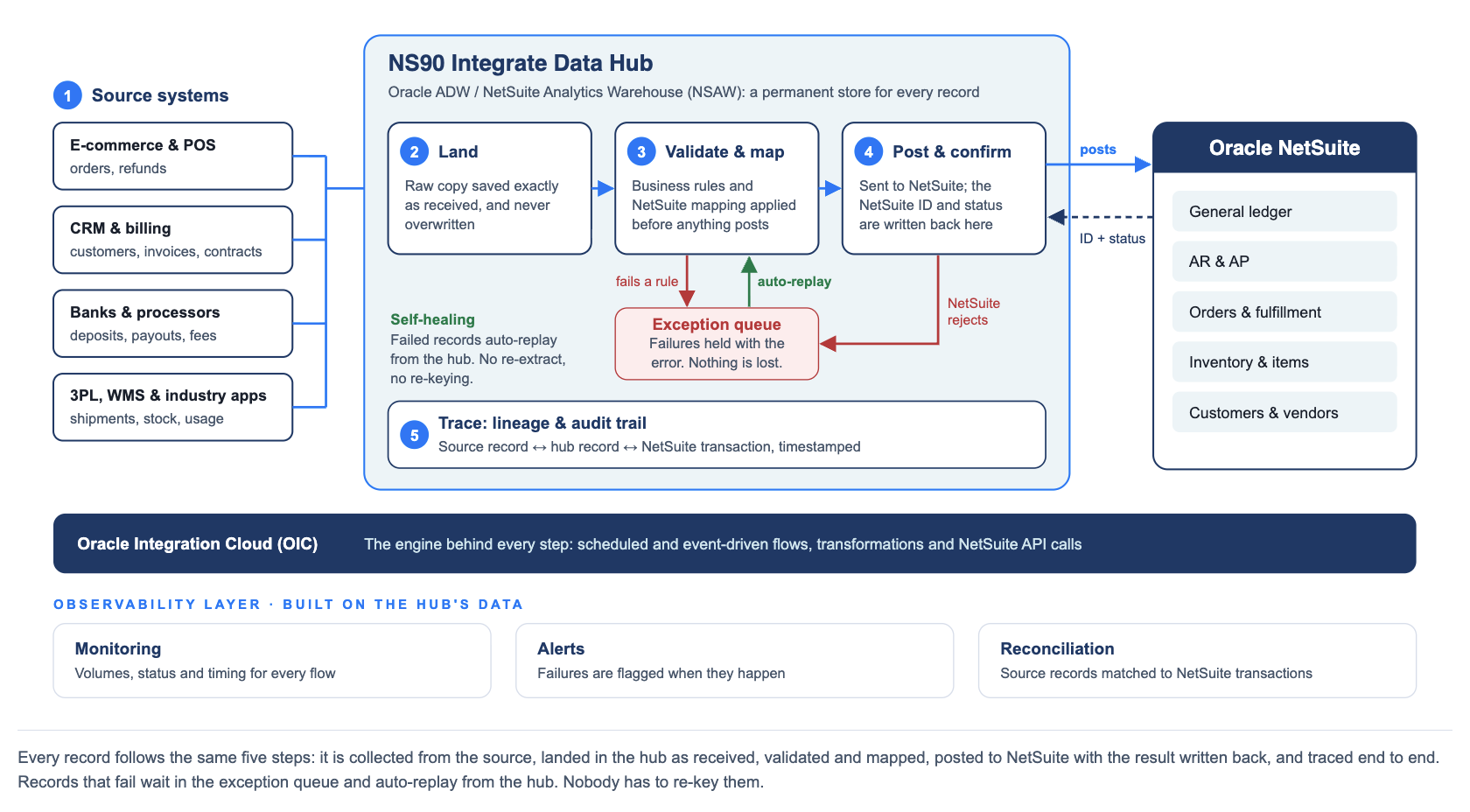
For businesses facing extreme spikes, Myers-Holum's integrated data platform — the NS90 Integrate Data Hub — provides a fundamentally more resilient model than point-to-point integrations. Instead of moving each record in a single fragile pass, incoming data is landed, transformed, and staged before it's posted to NetSuite. That delivers three key advantages:
High performance. Transformation logic runs locally inside the database directly rather than through real-time lookups calling external APIs, so tens of thousands of records can be prepared quickly.
Self-healing error handling. Records with issues — a missing item or an unmatched customer, for example — wait safely in the hub instead of failing outright. "Once the missing item or lookup is fixed, the hub automatically retries and posts the record," Mo says. "You typically only need to address the root cause and wait for the next run."
Controlled throughput. The hub acts as a queue, buffering orders when downstream systems are at capacity and retrying automatically until they succeed. Nothing gets lost in the rush.
The result is an architecture built to absorb the surge, so your team can focus on fulfilling orders rather than chasing them.
Black Friday is coming — is your architecture ready?
Handling peak-season volume doesn't require ripping out your ERP or adopting an oversized enterprise platform. It requires designing your integrations for your busiest hour, not your average day — and having an architecture that degrades gracefully instead of failing loudly.
Whether you're preparing for this year's rush or already planning for next year's growth, Myers-Holum can help you assess your peak volumes, identify bottlenecks before they cost you, and build an integration architecture that scales with your business.
Click Here to Talk to a Myers-Holum integration expert about your peak-season readiness